
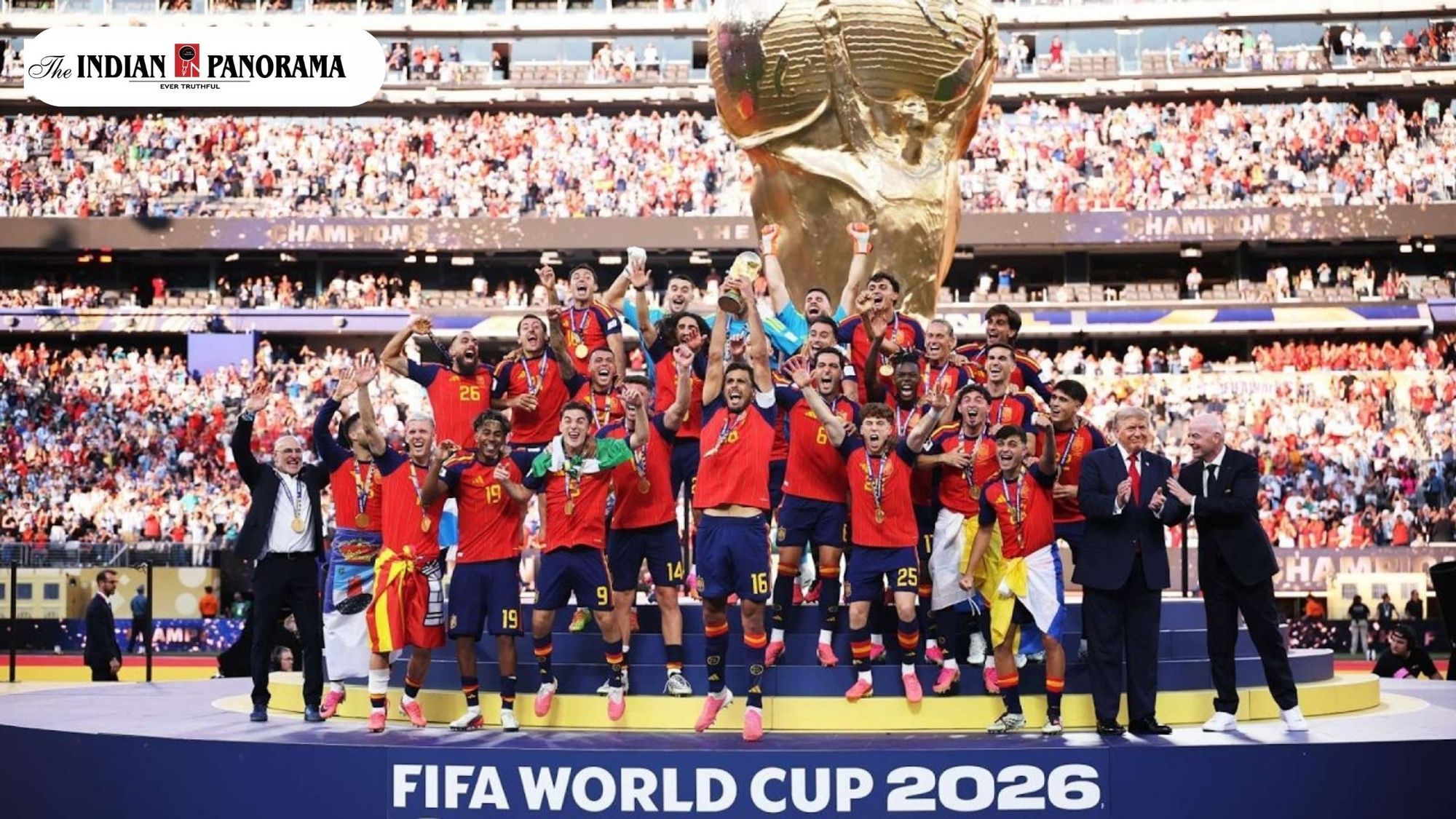
Spain won the FIFA World Cup 2026, defeating defending champions Argentina 1-0 after extra time in a tense final played at New York New Jersey Stadium (MetLife Stadium) in East Rutherford on July 19. The victory gave Spain its second World Cup title, its first since 2010, and brought an end to Lionel Messi's storied World Cup career in heartbreaking fashion for Argentina.
The final, watched by more than 70,000 fans inside the stadium and an estimated 1.5 billion viewers worldwide, stayed goalless through 90 minutes of tightly contested football. Argentina goalkeeper Emiliano Martinez produced save after save to keep Spain at bay, eventually finishing the match with a record 11 saves in a World Cup final. Spain, however, dominated possession and shots throughout, outshooting Argentina 20 to 2 and recording an expected-goals tally of 1.94 against Argentina's 0.2.
What Turned the Match in Spain's Favour?
The breakthrough came deep into extra time. Argentina midfielder Enzo Fernandez was shown a second yellow card in stoppage time at the end of regulation, reducing his side to ten men. In the second period of extra time, substitute Ferran Torres pounced on a header from Nico Williams and buried the ball past Martinez in the 106th minute, sealing a 1-0 win that sent Spain's bench and travelling fans into celebration.
How Did the Tournament Unfold for Both Finalists?
Spain's run to the title was built on defensive discipline as much as attacking flair. Coached by Luis de la Fuente, the side conceded only a single goal across the entire tournament, defeating Austria, Portugal, Belgium, and France on its way to the final and becoming the first Fifa World Cup champion to win the tournament while conceding just once. Argentina, chasing back-to-back titles after its 2022 triumph, beat Cape Verde, Egypt, Switzerland, and England en route to the final, but its bid to become the first repeat champion in more than six decades fell short.
A few numbers from the tournament capture just how significant this edition was for football's global reach:
- The 2026 World Cup was the first to feature 48 teams, expanding from the previous 32-team format.
- Spain's win extended its unbeaten run in major tournaments to 38 matches, adding to its Euro 2024 title.
- Nineteen-year-old Lamine Yamal completed a rare Euro and World Cup double with Spain within two years.
- Midfielder Rodri won the adidas Golden Ball as the tournament's best player.
- Argentina's Messi, at 39, contributed eight goals and four assists across the tournament in what is widely seen as his final World Cup appearance.
What Made This Final Historic Beyond the Scoreline?
Sunday's final also carried cultural weight as the first World Cup final to feature an official halftime show, with performances from Shakira, Madonna, Justin Bieber, BTS, and the Muppets, extending the halftime interval well beyond usual length. For Indian football fans, many of whom stayed up through the night to follow the tournament hosted jointly by the United States, Mexico, and Canada, the final capped a month-long tournament that reintroduced football to American mainstream audiences at an unprecedented scale.
With Spain now doubling its World Cup tally to two titles, only France and Uruguay share that distinction among two-time champions, while Brazil, Germany, Italy, and Argentina remain ahead on the all-time list. Attention now turns to the 2030 World Cup, jointly hosted by Spain, Portugal, and Morocco, where Spain will look to become just the third nation to defend the trophy successfully.